The decorating notebook
Repainting railings and basement areas
Iron and basement areas fail in a different way from the wall behind them. They hold water, they rust, and on several of these streets they sit directly over the pavement.
The iron the audit actually describes
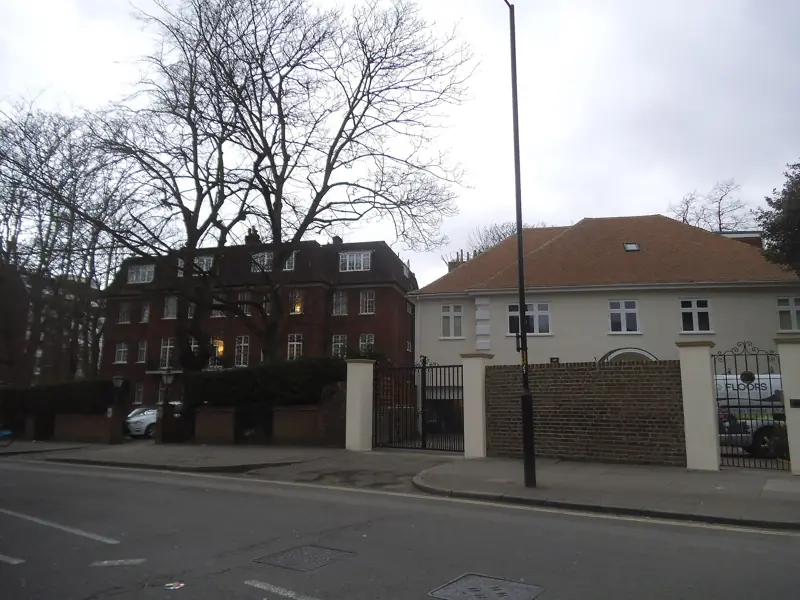
There is no single St John's Wood railing. Abbey Gardens has iron balconies supported on pillars, in front of half-stuccoed brick. The early Hamilton Terrace terraces have a wrought-iron balcony as one of their few decorations, above a stucco basement. St Anne's Terrace has decorative cast-iron balconies on a palace front. Acacia Road is illustrated with spearhead railings on a half-stucco wall. St John's Wood Road has a bottle balustrade, which may be masonry rather than iron and has to be identified before it is given a metal paint. Nos. 83-86 Prince Albert Road are four stucco houses facing the park, with decorative first-floor balcony railings. Mews houses normally have cast-iron rainwater goods rather than a long run of spears. A quotation that says 'railings' without saying balcony, spearhead, rainwater pipe or balustrade is guessing.
Basement areas are a place, not a colour
On the early Hamilton Terrace houses the stucco basement is part of the architecture. It is the rendered storey at the bottom, often the wet one, under the wrought-iron balcony. On Abbey Gardens the front garden is limited or absent and the area, where there is one, is hard against the pavement. Hannover House on the High Street is five storeys over a basement. Prince Albert Road's stucco houses are described with a basement as well as the upper floors. Preparation of a basement wall is stucco work: hollow render cut out, a sound film cleaned, no textured paint. The iron in front of it is separate. Leaves, grit and standing water in the area are cleared so you are not painting rust that is still damp. Drains in the area are kept open. Wash-down does not go down them as a slurry of old paint. If the area is the only way to the lower door, the householder still needs a route. That is planned before the rail is taken off.
Preparing iron
Rust and thick paint are the two enemies. The method is mechanical and careful, and it assumes old coatings may contain lead.
Sound paint stays; rust does not
Flaking paint and loose rust are removed back to a firm edge. Sound paint is left. Lead pigments were used until the 1960s, so the same bans apply as on joinery: no blow lamp, no gas torch, no dry sanding that fills the area with dust. A wire brush used gently, with the dust caught rather than swept into the basement, is the ordinary approach. Spearheads, cast leaves on a St Anne's balcony, and the junction where a bar enters stone or stucco are the pieces people rush. Paint and rust both sit in those joints and split the fixing. They are cleaned out, not flooded with a heavy coat that looks smooth for a month.
Keep the iron off the wall
Mask the stucco, the brick and the stone before any metal coating goes on. Masonry paint brushed along a railing stains the bars and seals water against the wall. Metal paint brushed onto brick is the negative change the audit already dislikes, done by accident. Pillars that carry the Abbey Gardens balconies are checked: some reads of those fronts treat the support as part of the iron assembly, and the survey confirms the material before the colour is chosen. Rainwater goods in a mews are taken down if the joints allow, prepared, and put back so they still discharge into the hopper rather than down the yellow stock. Cast iron that is cracked is reported. Paint will not stitch it.
Basement stucco beside the rail
The rendered basement is repaired before the iron is finished, so that dust from cutting out does not fall on wet metal paint. A compatible filler or render brings hollows back. Gloss or eggshell is the stucco finish, not a textured masonry paint, and not a mirror gloss. The colour of the basement is often quieter than a front door and related to the upper stucco. On a half-stucco street it must not be used as an excuse to continue the coating up over the yellow or red brick. Fair-faced brick stops where it stops. The junction is cut in with a brush. Balustrades of stone or terracotta, including the bottled balustrades on the Edwardian houses of St John's Wood Road, are not given this metal system. If they are unpainted, they stay unpainted.
Access, fans and the pavement
Balcony iron on an upper floor is reached from scaffold, not by leaning out of the sash you have just painted. Where falling rust or tools could reach pedestrians or vehicles, a protective fan is required. Abbey Gardens, Alma Square and the High Street are the obvious pavement cases. A villa garden with a spearhead rail at the boundary, as on the Acacia Road illustration, may be painted from the garden side if the planting allows, and the piers are protected. Granite setts in a mews are covered before a rainwater pipe is rubbed down. Highway scaffold needs a licence. None of that is optional extra once the iron is above a public way. The licence and the fan are in the plan that accompanies the quotation.
What we need from you
Tell us whether the job is a balcony, a boundary rail, a basement area, rainwater goods, or some of each. Photographs of the rust at the foot of a bar, and of the basement wall behind, show more than a sunny view of the whole house. Say if the rail is the only guard to the area, because it cannot be left off overnight without a temporary protection we have agreed. Listing and Article 4 still apply if the colour of a street-facing element changes on a controlled address. Like-for-like maintenance of already painted iron is the ordinary case. Coating a bare stone balustrade is not. The quotation separates metal, basement stucco, repairs and access.
Questions about Repainting railings and basement areas
Which streets does the audit actually show iron on?
Examples include iron balconies on Abbey Gardens, wrought-iron balconies and stucco basements on early Hamilton Terrace, cast-iron balconies on St Anne's Terrace, spearhead railings on Acacia Road, and cast-iron rainwater goods on traditional mews houses.
Can balcony paint continue onto the brick behind it?
No. The metal coating stays on the metal. Fair-faced brick is left unpainted, and masonry paint should not be brushed across the bars.
Do basement areas need a fan?
A protective fan is required where falling material could reach pedestrians or vehicles. On streets with little or no front garden, such as Abbey Gardens, upper iron is often over the pavement.
Related reading
Adjoining streets and wider work
Railings and basement areas on terraces of this kind are also described by Paddington painters and decorators and Primrose Hill painters and decorators.
Where the elevation needs repair beyond decoration, that wider exterior work sits with Hampstead Renovations.
Request a quotation
Tell us about your property.
Share the address, the rooms or surfaces, and what you have in mind.
Your project details
Tell us what you would like to decorate and where.