St John’s Wood & its neighbourhoods
Hamilton Gardens painting | red-brick Gothic terraces
Hamilton Gardens is not Hamilton Terrace. It is four red-brick terraces with Gothic detailing, and the paint has to follow the brick, the pointed doors and the roof.
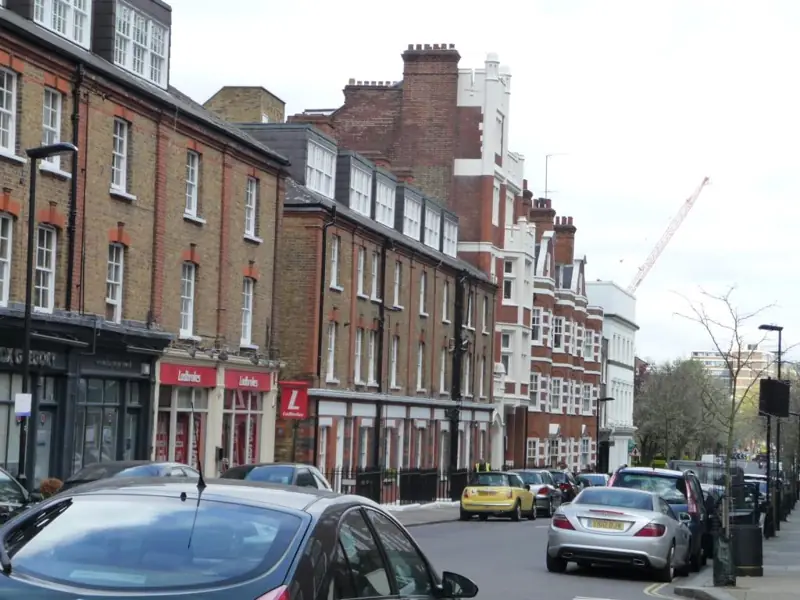
Hamilton Gardens across St John’s Wood (NW8)
Four terraces, red brick, Gothic detailing
The boundary study says Hamilton Gardens comprises four red brick terraces with Gothic detailing very similar to the Queen's Park properties, whilst Alma Square is faced in stucco. That is the material split. These are not fully rendered Italianate villas and they are not the yellow-stock terraces at the south of Hamilton Terrace. The brick is meant to be read as brick. Stucco is the detail, not the whole wall. The same passage says the buildings fall in the later part of the nineteenth century, between the first development and the Edwardian phase, and that the enclave was omitted from the original designation because it was not part of the original garden-suburb architecture. It was still judged to be of significant townscape value. Painting advice starts from the brick and the Gothic detail, not from a villa palette borrowed from another street.
What the 1870s fronts actually show
The townscape chapter is more precise. The 1870s terraces on Hamilton Gardens have simplified Gothic details, particularly the pointed arches over the doors. They are built in red brick with stucco detail, with low-pitched roofs, no parapet, stout chimneys and brick upstands dividing the roofscape. A decorator's schedule can be drawn almost straight from that list. Door arches in stucco or painted render, kept to the arch and not spread onto the red brick. Stucco dressings only where they already exist. Chimneys and upstands left as brick unless they are already coated, because painting fair-faced brick is something Westminster's stucco guide says should never be done, and the audit treats brick painted above the ground floor as a change that disrupts a terrace. The low roof with no parapet means the eaves and the chimney brick are visible from the street. They are not hidden behind a parapet the way a classical terrace often is.
Dormers are already named as a problem
Large dormers to Hamilton Gardens are illustrated in the audit's negative-features discussion of roof alterations. The wider text says poorly detailed roof extensions are unsympathetic, and that roof gardens with railings, trellises, stairs and screens cause clutter, particularly where a terrace has been formed on a mansard. Hamilton Gardens is the captioned example for large dormers. A repaint does not remove a dormer, and it should not be used to make a clumsy roof extension look deliberate by painting it into a new composition. Joinery on a dormer cheek or a roof window is specified on its own, in a colour that does not pretend the roof was designed that way. If the work is only decoration, the quotation says so, and it does not include rebuilding the dormer.
A backwater that is easily spoilt
Hamilton Gardens and Alma Square are described together as a charming secluded backwater whose sense of place could be easily spoilt by insensitive alterations. One of the two main concentrations of terraces in the conservation area lies between Blenheim Terrace and Hamilton Gardens, so this street is also part of a larger terrace pattern, not an isolated close. Insensitive alteration, on a red-brick Gothic terrace, is easy to picture: painted brick, a lost pointed arch, a plastic door, a roof cluttered with new work. The decorating half of that list is the part we can specify. Keep the pointed door joinery, repair the stucco dressings, and leave the red brick. Doors in the conservation area are typically painted, often black, with other colours occasional. A pointed Gothic door is not the same as a flat classical door, but the habit of painting it, rather than stripping it to a varnish, matches the audit's general account of front doors.
Quoting a red-brick terrace
The cost of this work turns on how much stucco detail has failed, whether anyone has already painted the brick, how the pointed door joinery is opening, and how the low roof and chimneys are reached. It does not turn on a rate per house. We visit, then write an itemised quotation that lists brick that stays bare, stucco that is repaired and coated, doors, and any iron. Old paint on joinery may contain lead. It is not burnt off, and only flaking, chipping or dusting paint is taken back. If you want the job priced, send the address and photographs of a whole house, including the door arch and the roof, and request a quotation.
Questions about Hamilton Gardens
Are Hamilton Gardens and Hamilton Terrace the same kind of house?
No. Hamilton Gardens is four red-brick terraces with Gothic detailing, dated in the audit to the 1870s, with pointed arches over the doors. Hamilton Terrace is a wide formal street of villas and earlier yellow-stock terraces. The names are related. The buildings are not.
Should the red brick be painted to freshen the terrace?
The audit describes these terraces as built in red brick with stucco detail. Painting brickwork above the ground floor is recorded as a harmful change, and the stucco guide says fair-faced brickwork should never be painted. The stucco dressings are the painted part.
What roof detail affects the job?
The roofs are low-pitched, with no parapet, stout chimneys and brick upstands. Large dormers on Hamilton Gardens are shown among alterations the audit treats as harmful. A repaint should not be asked to disguise that roof.
Related reading
Adjoining streets and wider work
Where a Victorian terrace needs repair as well as decoration, that wider work sits with Hampstead Renovations.
Decorating services in Hamilton Gardens
Neighbouring areas
Painters and decorators beside St John's Wood
These are the decorating sites for the areas that sit beside St John's Wood.
Request a quotation
Tell us about your property.
Share the address, the rooms or surfaces, and what you have in mind.
Your project details
Tell us what you would like to decorate and where.