St John’s Wood & its neighbourhoods
Hamilton Close painting | yellow-stock mews houses
Hamilton Close is one of the complete mews in St John's Wood. The front to paint is a two-storey stock-brick wall over a timber carriage door, not a villa elevation.
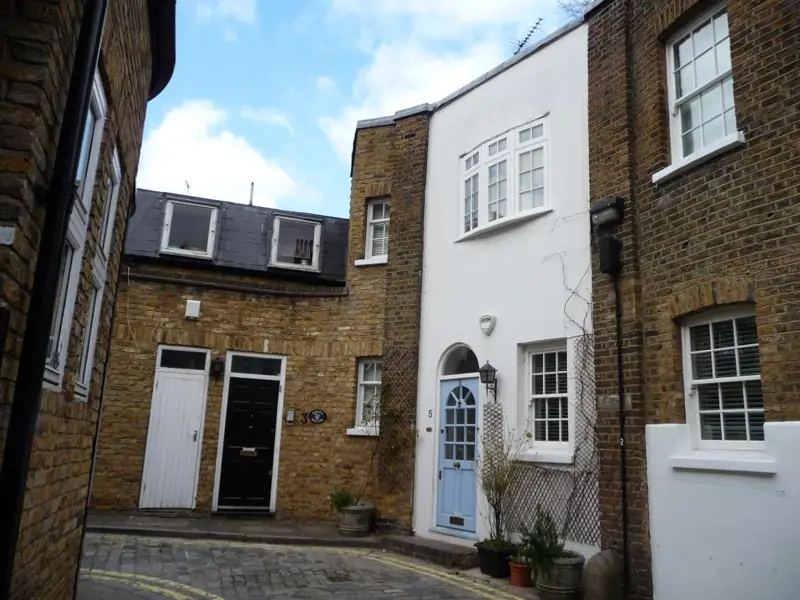
Hamilton Close across St John’s Wood (NW8)
One of the mews that still reads as a mews
The audit says there are intimate mews spaces with no gardens at all, and it names the most complete examples as Hamilton Close, Rutland Mews, Ryder's Terrace and Queen's Grove Studios. A later paragraph is more specific about survival. Abercorn Close, Langford Close, Rutland Mews, Hamilton Close and Northwick Close are well preserved, retaining arched entrances, granite setts with drainage channels, stone bollards and unaltered mews buildings. Hamilton Close is in both lists. That is why a decorating brief here starts with what must not be modernised out of the picture: the arch, the setts, the bollards and the unaltered building. Paint is the reversible part. A replacement door or a lost sett is not.
Yellow stock, a small upper opening, a timber carriage door
The traditional mews house, in the audit's words, is a modest two-storey building in yellow stock brick, with small openings at first-floor level, over timber carriage doors. They normally have cast-iron rainwater goods. That is the whole elevation. There is no stucco palace front and no half-basement villa to schedule. The brick is stock brick and, unless it has already been painted, it stays brick. Westminster's stucco guide says fair-faced brickwork should never be painted, and the audit records painted brick above the ground floor as a harmful change. The carriage door is the large timber surface. It is joinery exposed to the weather, and the audit says regular painting of doors and windows is essential if decay is not to take hold. The small upper openings are the windows: little, and easy to lose under a thick coating or a replacement frame. Cast-iron rainwater goods are painted as metal, in a colour that does not pretend they are timber.
Setts underfoot and what other mews have lost
Only a few granite-sett surfaces remain. Hamilton Close, Charles Lane and Rutland Mews are the examples named. Where they survive they contribute to the intimate character of the smaller streets. A painting job does not relay setts, but it can spoil them: spilled coating, grinding dust, a board left on the channel. Protection of the setts belongs in the method, not as an afterthought. Charles Lane is the comparison the audit uses for a less complete mews: buildings with additional storeys, replacement metal garage doors, and granite setts lost. The negative-features section says modern garage doors have had a negative impact, particularly in the mews. If a Hamilton Close door is still timber, the specification keeps it timber and painted. It does not propose a metal garage door as an improvement. If a door has already been replaced, that is recorded as it is. We do not claim a timber door is there when it is not.
Working in a close with no garden
Mews have no gardens, and the building lines are the tightest the audit describes. Materials, a ladder and a drying door all share the same narrow ground as the sett channel and the neighbour's entrance. There is nowhere to fade into. Sequence matters: one door at a time if people still need to get a car or a bicycle out, dust kept off the setts, and rainwater goods reached without standing on a hopper. Where anything could fall towards people, a protective fan is the scaffolding requirement. Old door paint may contain lead and is not stripped with heat. Sound paint stays. Only flaking, chipping or dusting paint is taken back. An arched entrance that is still fair brick is masked and left. If the arch has already been coated, that coating is maintained rather than carried onto the stock beside it. The written scope names which neighbour's front is not included, because the Close is shared. The quotation is itemised after a visit: brick left bare, timber doors, small upper windows, cast-iron goods, and protection of the setts. Send photographs of the arch and the door, and request a quotation.
Questions about Hamilton Close
What is the usual mews front in Hamilton Close?
The audit describes the traditional mews house as two storeys of yellow stock brick, with small first-floor openings over timber carriage doors, and normally with cast-iron rainwater goods. Hamilton Close is named among the well-preserved mews that still have unaltered buildings.
Should the stock brick be painted white?
The brick is yellow stock, and fair-faced brickwork should not be painted. Painted brick above the ground floor is recorded as a change that disrupts a terrace. The painted surfaces are the timber door, the small windows and the iron goods.
Why mention the granite setts in a painting enquiry?
Hamilton Close is one of the few places where granite setts remain. They are part of the mews character. Paint spills and dust will mark them, so protection of the ground is part of the job even though the setts are not being painted.
Related reading
- Exterior painting for carriage doors and stock-brick mews fronts
- Hamilton Terrace, the wide street this close serves
- Queen's Grove, whose studios are grouped with the complete mews
- Exterior painting for doors, brick and iron
- Joinery painting, including timber doors
- How small timber windows and sashes are prepared and painted
Adjoining streets and wider work
Mews of stock brick, of the kind behind these terraces, are also described by Paddington painters and decorators.
Where an older house needs repair as well as decoration, that wider work sits with Hampstead Renovations.
Decorating services in Hamilton Close
Neighbouring areas
Painters and decorators beside St John's Wood
These are the decorating sites for the areas that sit beside St John's Wood.
Request a quotation
Tell us about your property.
Share the address, the rooms or surfaces, and what you have in mind.
Your project details
Tell us what you would like to decorate and where.