St John’s Wood Painters & Decorators
Interior decorating
Interior painting and wallpaper are the two inside services. One covers the walls and ceilings you occupy. The other covers paper, any lining, and the wall that has to take it. In St John's Wood the building changes the route and what you may alter. It does not change which service is which.
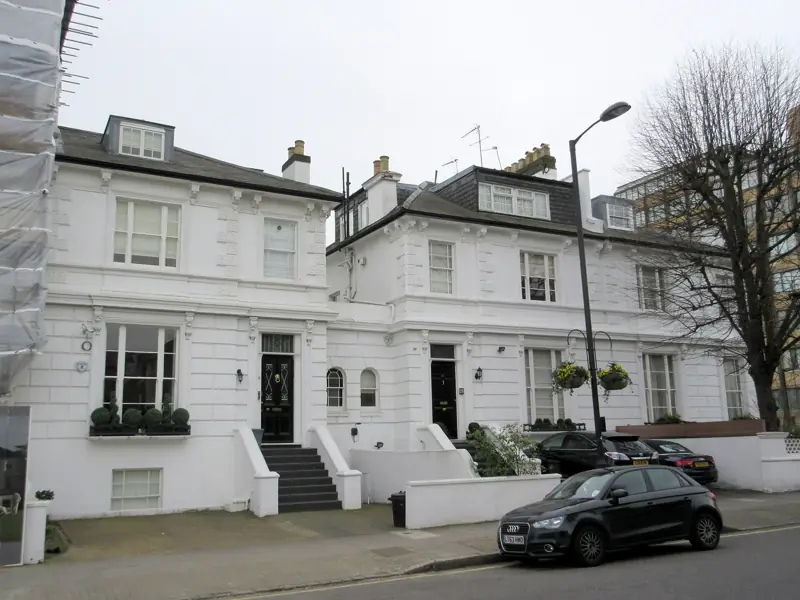
Interior decorating across St John’s Wood (NW8)
Interior painting
A room in St John's Wood should feel resolved from the ceiling line to the skirting. Begin with the surfaces, the light and the way you want to use the space.
Read about interior painting 02Wallpaper & wallcoverings
A wallcovering brings its own rhythm to a room in St John's Wood. Consider the wall beneath it and the position of every seam before ordering the final quantity.
Read about wallpaper & wallcoveringsWhat interior painting covers in the rooms you occupy
Interior painting is the service for the plaster and the previously painted walls and ceilings you name. A useful brief lists rooms, then says which surfaces change and which stay as they are. A ceiling that meets a cornice needs its own line: with the ceiling, with the wall, or in a third tone. Halls and the soffit of a stair belong in that list when people see them with the rooms. In a mansion flat the private hall is part of the home, and the common stair is a different surface, included only when the managing agent has put it in writing. Doors, shutters, skirtings and architraves are joinery even when they are painted in the same week. The paint colour on a wall should stop where you say it stops, so it does not spread onto a shutter you meant to keep. Fitted cupboards need a yes or no for shelves and for the backs of doors. Where a wall is going to be papered, take it off the paint list. The preparation and the order both change once paper is involved. Photographs for this service should show corners, cornices and any crack or patch, not only the middle of a clear wall. That is the difference between naming a room and describing a scope someone can compare.
What wallpaper covers, and where paint continues
Wallpaper is a different operation on the same wall. The enquiry needs the product, the pattern repeat, the roll width and the maker's hanging note, plus a decision about lining. The wall beneath has to be sound and evenly absorbent before paste goes on. An existing paper comes off only when the brief says it comes off. A stain, a damp patch or a loose skim is preparation or repair. A new pattern is not there to hide it. Paper has edges, and those edges are part of the instruction. It may stop at an architrave, turn into a reveal, or end on a line agreed beside a shutter. Interior painting continues on the ceiling, on any wall marked as paint, and on the joinery if that joinery is in its own service. In a room with a chimney breast or a shutter box, the place where the repeat starts is a choice. A length that looks centred on an open wall can collide with the first obstacle. Ceilings in these homes are usually painted. A papered ceiling is a separate request, and only where the product allows it. Send the awkward walls in the photographs. The clearest wall is rarely the one that decides the number of drops.
Flats above the street and rooms in the villa streets
Westminster's audit describes the High Street as terraces and as Victorian, Edwardian and interwar mansion and flat blocks, with shops at ground level and shopfronts detailed in groups. An interior brief there starts inside the rooms on the lease. Grouped fronts, fascias and common landings are not an extension of a room colour. Ask who controls the flat's entrance door before it is treated as your joinery, and ask how lengths of paper and tins of paint may come up the stair or the lift. Abbey Road needs the same split read from the address. The audit records early twentieth-century mansion blocks on parts of Abbey Road and Grove End Road, and 1860s yellow-brick terraces with partial stucco in Abbey Gardens. A flat and a house on that road do not share a route or a schedule. On the villa streets the audit describes early and mid-Victorian houses in brick and stucco, with gardens, and semi-detached houses composed so that a pair reads as one villa. Inside, that often means a hall seen with every room, a stair, and windows on more than one side. Interior painting and wallpaper still stop at the inner face of the window. The stucco outside is the exterior service. Use the neighbourhood page that matches the address to see which of these settings you are in, then write the rooms into the enquiry and leave the street's history on the neighbourhood page.
Sources: Westminster: High Street buildings and shopfronts; Westminster: Abbey Road and Abbey Gardens; Westminster: St John's Wood conservation area audit
What to send for paint, and what to send for paper
For interior painting, send the full address, the room list, and whether the ceiling, the walls and the cornice are included in each room. Say which rooms must stay in use, what furniture can move, and whether a managing agent controls hours, protection, and the way materials enter. If the product is already chosen, send the manufacturer, the colour reference and the sheen for each surface. If it is not chosen, say the specification is open. Colour planning is the service for that gap. A start date should not pretend the choice has been made. For wallpaper, send the same address and the walls to be papered, with the product details or enough of the sheet to see width, repeat and hanging method. Say whether lining is required, and mark where paper ends and paint begins. Where both services are needed, keep them as two lists in one message. A survey can look at both on the same visit. A single sentence that says the flat needs decorating cannot be priced without guessing which walls are paint, which are paper, and which are being left alone. Unknowns written as unknowns are more useful than a smooth description that hides them.
Local points for paint and paper inside St John's Wood buildings
Earlier mansion flats in St John's Wood are red brick with white stone or stucco dressings. An interior scheme in one of those blocks is for the rooms on the lease. The red brick and the white dressings belong to the outside of the building.
For listed flats and houses, Westminster generally does not control internal painting. Paint and paper inside the demise can usually be discussed as decoration, while a common part, or a proposal to remove an original scheme, is a separate question.
Shared halls and stairs in a block of flats fall under Approved Document B's minimum lining classification of B-s3, d2. If the agent has asked for the common stair to be included, the product is chosen against that class.
Adjoining streets and wider work
Interior decorating for these houses and flats is also set out by Primrose Hill painters and decorators and Marylebone painters and decorators.
Request a quotation
Tell us about your property.
Share the address, the rooms or surfaces, and what you have in mind.
Your project details
Tell us what you would like to decorate and where.