The decorating notebook
Caring for and repainting timber sash windows
A sash is a moving timber frame, not a strip of wood around the glass. In St John's Wood the audit's windows include ordinary six-over-six sashes, round-headed openings and curving bows. The paint has to let them keep moving.
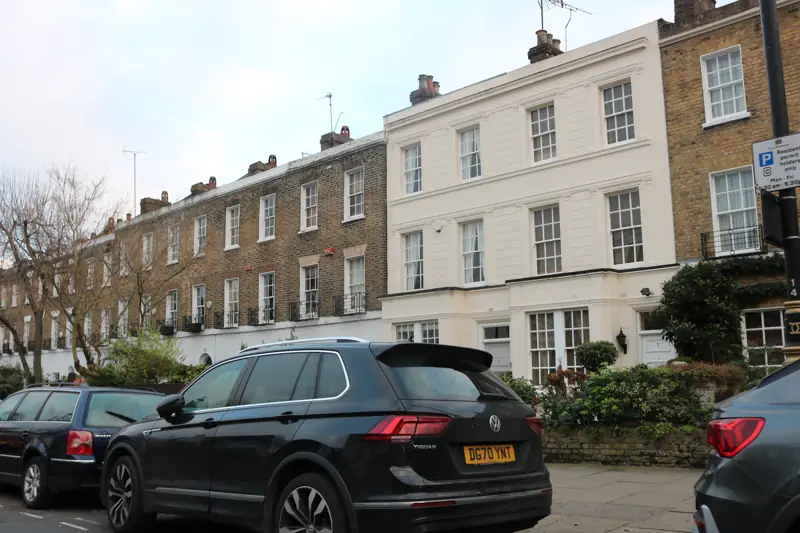
What the local windows actually are
The conservation-area audit says six-over-six sashes, often with margin lights, are the most common glazing-bar pattern. That is a thin bar, easy to drown in paint. Round-headed windows appear more often in the south and in particular on Hamilton Terrace, where the early yellow stock terraces use round-headed doors and windows as almost their only decoration. Queen's Grove Terrace is drawn with sashes sitting in stucco surrounds between giant pilasters, so the timber and the render meet on a line you have to respect. St John's Wood Road's grander terraces have curving bow windows at ground floor. A bow's cill and meeting rails follow a curve. Later buildings complicate the picture again: the audit notes timber sashes on 1930s neo-Georgian blocks, and side-hung casements more often on the Tudor Gothic houses. Identify the window before you name the work. A casement is not a sash, and a bow is not a flat sash with a wider cill.
Look at the window before you paint it
Open the sash if it will open. Note whether it sticks, whether the cords still hold, and whether the meeting rails meet. A decorator's repaint is not a full window restoration, and this guide will not pretend it is. It is the moment to see decay. Soft cills, cracked putty and paint that has bridged the staff bead are the usual findings. Regular painting, the audit says, is essential if doors and windows are not to decay. Leaving a bare cill through another winter is how a paint job turns into a splice. Write down the faces you want: outside only, inside only, or both, plus the frame, the cill and the beads. In a flat, the outside may not be yours. On a palace front or a terrace the outside is part of the elevation and is often done with the stucco, masked so the masonry paint stops at the timber.
Preparation that keeps the bars
Old sash paint is a lead risk. Household paints used lead pigments widely until the 1960s. The method follows from that.
Do not burn and do not dry-sand
Blow lamps and gas torches are out. Dry sanding is one of the jobs that puts people most at risk from lead dust. Sound paint stays where it is attached. Flaking, chipping and dusting paint is the part that comes off, taken back to a firm edge. A chemical stripper, if one is used at all, is a specification decision for a badly clogged moulding, not a default, and it is not named by brand here. The aim is a sound surface and a glazing bar that still has its shape. Margin lights disappear if each coat is heavier than the last. Where earlier paint has already filled the quirk of the bar, say so. Cutting that back is slower than over-coating it, and it should be visible in the quotation rather than hidden inside 'prepare and paint'.
Putty, glass and ironmongery
Failed putty is picked out and replaced so the glass is bedded before the finish goes on. Glass is masked. A cracked pane is reported, not painted over as if the crack were a shadow line. Fasteners, pulleys and sash lifts are masked or taken off and put back. Paint in the pulley makes a window that will not stay open. Paint on the meeting-rail joint makes a window that will not close. The staff beads, which come off on a traditional sash when the window is adjusted, are painted on their edges too, or they flash bare timber the first time someone eases the sash. We do not promise new cords or a draught-proofing system on a decorating specification unless that work has been asked for and seen.
The curved and the round-headed cases
On a bow, the cill is a curve and the sashes are narrow. Masking tape cuts across the curve if you treat the bay as three flat windows. Preparation follows the arc, and the coating is not piled in the internal angle where the bow meets the wall. On a round-headed window the head is the part that sticks. Paint is kept out of the clearance. The lining of the head is joinery, and the stucco arch around it, where there is one, is masonry. Two systems meet. On Queen's Grove the stucco surround and the giant pilaster are not 'the window'. They are the wall the window sits in. Brushing one product across both is how the timber edge fails and the render stains. Hamilton Terrace's 1930s flush door is a reminder that not every opening on a period street is a sash at all. Doors are a related job, with the same lead-safe rules, and they are specified as doors.
Inside faces, occupied rooms, and listed houses
The room side of a sash is seen against the wall colour. It can match the joinery or the wall. Say which. Floors, sills and curtains are protected. An occupied room usually needs the sash back the same day, so the work is staged window by window rather than with every sash out of the house. Internal painting of a listed building is generally not controlled. The outside, and any change from a painted window to a stripped one, can be. Westminster does not want painted doors replaced by stained or varnished ones, and the same caution applies to stripping a painted sash for a bare-timber fashion. Like-for-like repainting is the maintenance the audit is asking for. If the house is listed and you want a different finish, get advice before the paint comes off. Once it is off, the evidence and the protection have both gone.
Order of work and what we need in order to quote
Outside faces are easier with the elevation, from scaffold if the upper floors need it, with a fan where debris could reach the pavement. Inside faces follow once the putty and the preparation are sound, so you are not trapping dust in a wet coat. No number of coats is fixed on this page. The system depends on how much bare timber appears and what is already there. The quotation lists each window, the faces, repairs to putty or cills, and access. Send a photograph of the whole window and a close view of a meeting rail and a cill. Say if the sash does not move. That single fact changes the job more than the colour does.
Questions about Caring for and repainting timber sash windows
What sash pattern is most common in the conservation area?
Six-over-six, often with margin lights. Round-headed windows are more frequent in the south and on Hamilton Terrace. St John's Wood Road also has curving bow windows.
Can old sash paint be burnt off?
No. Lead pigments were widely used until the 1960s. Blow lamps and gas torches must not be used, and dry sanding is a high-risk way of making lead dust. Sound paint is left in place.
Is the stucco surround part of the sash?
No. On Queen's Grove Terrace the audit shows sashes in stucco surrounds between giant pilasters. The timber and the stucco are prepared and coated as different materials.
Related reading
Adjoining streets and wider work
Timber sash windows of this kind continue on the adjoining streets. See Marylebone painters and decorators and Hampstead painters and decorators.
Where a sash needs joinery repair as well as paint, that wider work sits with Hampstead Renovations.
Request a quotation
Tell us about your property.
Share the address, the rooms or surfaces, and what you have in mind.
Your project details
Tell us what you would like to decorate and where.