The decorating notebook
A local guide to painting and decorating period homes in St John's Wood
St John's Wood is not one kind of period house. The conservation-area audit moves from villa pairs in gardens to half-stucco terraces, red-brick Gothic, mews, a chapel portico and a retail parade. The paint follows that variety.
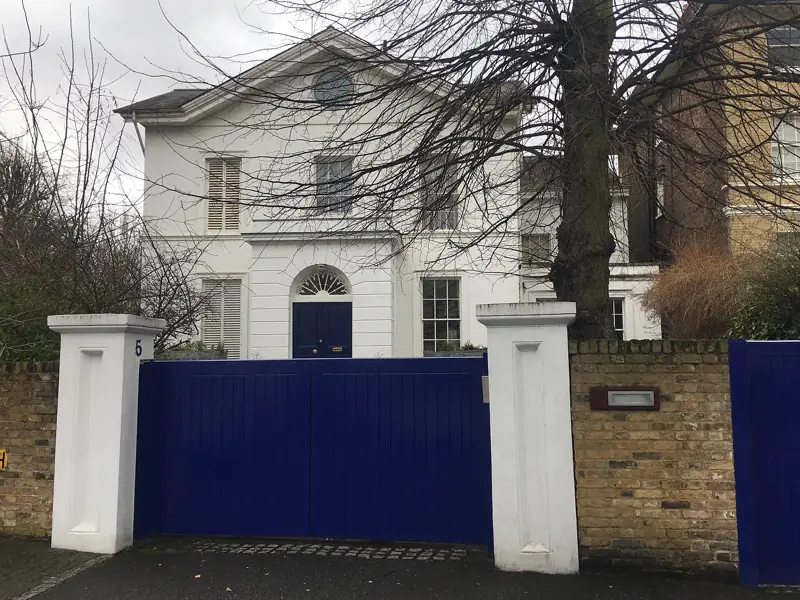
A garden suburb that later filled with terraces
Westminster describes St John's Wood as a very early garden suburb, and it says the character is being gradually spoilt, with insensitive painting of stucco among the causes. That is the sentence to keep beside any colour card. The estate story in the same audit starts earlier than the streets most people paint today. In 1803 John Shaw envisaged a circus of single or semi-detached houses standing in their own gardens on the Eyre land. In 1809 the first villas went up in Alpha Road, Beta and Omega Place, just south of the current conservation area. Leases required gardens and walls at least 6 feet high. The villa pages on this site start from that idea: a house in a garden, a boundary that was part of the architecture, and a pair that was often composed to read as one. Painting one half of a pair in a contrasting shade is the sort of change the 'insensitive painting' sentence is aimed at. Stucco across the area has generally been kept to a limited range of shades so that terraces and groups are not broken up.
Terraces that are not villas
The audit is just as interested in terraces, and they are not a fallback when a villa brief runs out. Abbey Gardens has later terraces of the 1860s: three storeys of yellow brick, half stuccoed, with iron balconies, a pronounced cornice and window dressings. Frontages are in the region of 5.5m and front gardens are limited or absent. Alma Square is faced in stucco and arranged around a protected garden. Hamilton Gardens, next to it, comprises four red-brick terraces of the 1870s with pointed arches, stucco detail and low roofs without parapets. St Anne's Terrace is a palace-fronted stucco range with a pediment above numbers 11-15 and giant Corinthian pilasters. Queen's Grove has a mid-Victorian terrace the study says should be preserved, illustrated with sashes in stucco surrounds between giant pilasters. St John's Wood Terrace has a former chapel of 1830-40 with a portico of giant Corinthian columns, now studios, and terraces named among the most complete. These are different coating jobs. A half-stucco brick front, a fully stuccoed square, a red-brick Gothic terrace and a palace front do not share a specification just because they share a postcode.
Mews, the High Street and the wide boulevard
The traditional mews house is two storeys of yellow stock brick over timber carriage doors, with cast-iron rainwater goods. Hamilton Close is one of the complete examples, with arched entrances, granite setts, drainage channels and stone bollards. Painting that brick is the opposite of looking after it. The doors and the iron are the decorated surfaces. Hamilton Terrace is another type again: particularly wide, with early plain yellow stock terraces from c.1830, stucco basements and wrought-iron balconies, and also earlier mansion flats of red brick with white dressings, three storeys including an attic. The High Street is a retail centre. Shops with homes over them are unified by red brick and stone dressings, and Hannover House is described as five storeys over a basement with an attic. A period-home brief that begins 'it's all stucco round here' will mis-specify every one of those streets. The useful brief names the material on the elevation you actually have.
What the council documents expect of paint
Fair-faced brickwork should never be painted. The audit already treats brick painted above the ground floor as a negative change, and on Abbey Gardens it says painting the brickwork would seriously disfigure the buildings. Stucco, where it is the finished surface, is a different matter. The stucco guide points to gloss or eggshell, not a textured coating, and it warns against an excessively glossy film. It offers BS 4800 colours 10B15, 08B17 and 08B15 as a way to match the predominant shade of a terrace or group. Those codes are guidance, not a claim that every house was painted to them. On a listed building, external painting needs consent where it affects special character, and a surface that has not been painted should not normally be painted. Historic England's version of the same idea is that like-for-like redecoration usually does not need listed-building consent, while painting a currently bare surface is likely to, and a change of finish, such as matt to gloss or smooth to textured, usually needs consent too. The Planning Portal's ordinary rule, that repainting a house does not need planning permission, is subject to listing and to Article 4 directions. The audit recorded 274 listed buildings in the designated area, so the check is an address check.
Sources
- Westminster City Council, Stucco: A Guide to Care and Maintenance
- Westminster City Council, Repairs and Alterations to Listed Buildings (SPG)
- Historic England, Listed Building Consent (Historic England Advice Note 16)
- Planning Portal, External walls: planning permission
- Westminster City Council, St John's Wood Conservation Area Audit
Article 4 is a street list, not a mood
Abbey Gardens is the local direction decorators actually have to read. It covers Nos. 1-47 (odd) and 2-56 (even). It controls development that affects the street-facing exterior, including painting of that exterior except the door. Painting the brick was one of the alterations brought under control because it would seriously disfigure the houses. The door is the stated exception. A new door colour is not, by that sentence, the same application as a new colour on the stucco. The direction does not travel with the words 'St John's Wood'. Hamilton Gardens is not inside it because the name sounds similar. St Anne's Terrace is not inside it because it is also a terrace. If you are on the numbers, the wall colour is a permission question. If you are not, you still have conservation-area character, listing if it applies, and the general warning against contrast and against painting brick. We do not treat a neighbour's recent repaint as consent.
Joinery, iron and the parts that are not the wall
Regular painting of doors and windows is, the audit says, essential to prevent decay. That is maintenance, not a suggestion to strip every door. Typical doors in the conservation area are painted black, with other colours occasionally, and fanlights are mostly rectangular, with semi-circular ones more often in the south. Six-over-six sashes, often with margin lights, are the common bar pattern. Hamilton Terrace adds round-headed doors and windows on the early stock terraces, and also shows a 1930s flush door with a canopy, so the street is not one joinery detail. Painted doors on listed buildings should stay painted rather than be swapped for stain or varnish. Iron appears as balcony bars on Abbey Gardens, as decorative cast iron on St Anne's Terrace, as a bottle balustrade and bows on St John's Wood Road, as wrought iron on the early Hamilton Terrace houses, and as rainwater goods in the mews. Metal is a separate system from masonry. Brushing wall paint across a railing glues the two together and traps rust against the stucco. Basement areas and narrow front gardens change how that iron is reached. Abbey Gardens often has nowhere to stand but the pavement. Alma Square has the least space between building lines apart from mews. Hamilton Terrace north of St Mark's has the greatest, over 40m.
Inside the house, and what is not controlled
Westminster generally does not control internal painting of listed buildings. That is not the same as permission to destroy a surviving scheme. The council asks that wall or ceiling paintings and important original decorative schemes be preserved. A period interior in this area may be a villa hall, a mansion-flat room over the High Street, or a mews house behind carriage doors. The decorating questions inside are still practical: which rooms, which ceilings, whether a lining paper or a textured coating is already there, and how furniture and stairs will be protected. Textured coatings are left alone rather than sanded, because older ones can contain asbestos. Old paint on joinery can contain lead, which was widely used until the 1960s. None of that requires a date for your particular door. It requires a method that does not burn, does not dry-sand, and does not strip sound paint for the sake of a bare surface. Circulation spaces in blocks of flats have a lining classification to consider when the common parts, rather than the private rooms, are in the job. A private hall and a common stair are different clients.
How to turn this into a brief
Write the address first, then the type as the audit would recognise it: villa, half-stucco terrace, stucco square, red-brick Gothic, mews, palace front, High Street parade, chapel portico. Say which elevations are in, and whether brick is to be left. Name doors, sashes, balconies and basement areas separately from the wall. Attach any listing note or previous advice, or say you have not checked. Photographs should show the whole bay and one detail that is failing. Say whether the house is occupied and whether a garden, a pavement or a shared mews is the way in. We quote after a visit, in writing, with repairs separated from decoration. The guides linked below go further into preparation, sashes, railings and cost factors. They still will not know your address until you send it.
Questions about A local guide to painting and decorating period homes in St John's Wood
Is St John's Wood all stucco villas?
No. The audit covers early villas in gardens, half-stucco brick terraces, a stucco square, red-brick Gothic terraces, mews of yellow stock, a chapel portico and a red-brick High Street. The coating follows the building.
Does repainting a period house need permission?
Ordinary repainting often does not. Listed buildings and Article 4 directions are the exceptions. On Abbey Gardens, Nos. 1-47 (odd) and 2-56 (even) are controlled for street-facing paint except the door. Listing is a separate check. The audit recorded 274 listed buildings in the designated area.
Should fair-faced brick be painted to smarten a front?
No. Westminster says fair-faced brickwork should never be painted. On Abbey Gardens the audit says painting the brick would seriously disfigure the buildings. Painted brick above the ground floor is already described as a negative change.
Related reading
- Heritage painting for period houses
- Exterior painting for stucco, brick edges and iron
- The Eyre Estate villa streets
- Abbey Gardens and its Article 4 Direction
- Alma Square, the stucco garden square
- Hamilton Close, a complete mews
- Preparing a stucco or brick front before repainting
- What affects the cost of painting in St John's Wood
Adjoining streets and wider work
Period houses of this kind are also described for the adjoining streets by Primrose Hill painters and decorators and Hampstead painters and decorators.
Where the building needs repair as well as decoration, that wider work sits with Hampstead Renovations.
If defects show up before redecorating, a condition survey can be discussed with Hampstead Chartered Surveyors, our sister surveying and building consultancy firm.
Request a quotation
Tell us about your property.
Share the address, the rooms or surfaces, and what you have in mind.
Your project details
Tell us what you would like to decorate and where.