St John’s Wood & its neighbourhoods
Exterior painting for the mews houses in Hamilton Close
Hamilton Close is a mews, not a terrace with a cornice. The paint sits on carriage doors and iron goods. The yellow stock brick is the part that stays unpainted.
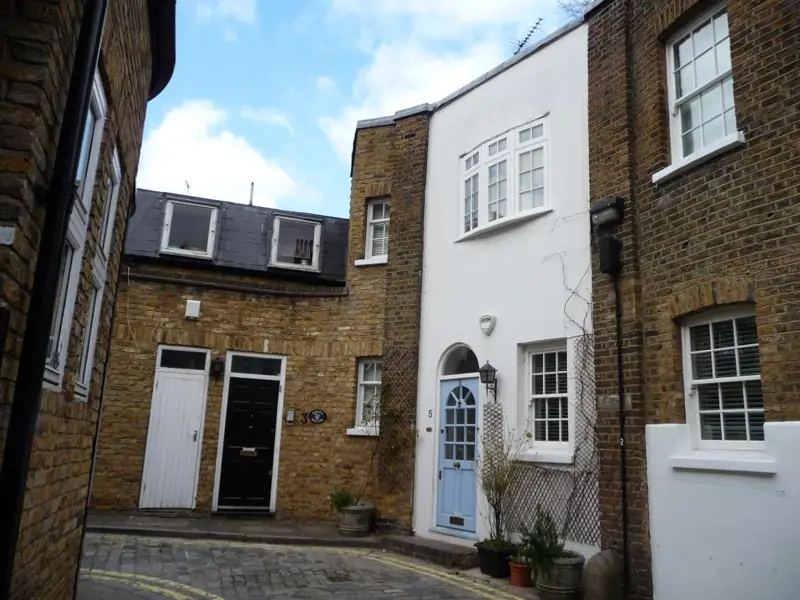
One of the complete mews
The audit names Hamilton Close with Rutland Mews, Ryder's Terrace and Queen's Grove Studios as the most complete intimate mews spaces. A second list groups Hamilton Close with Abercorn Close, Langford Close, Rutland Mews and Northwick Close as well preserved, and it mentions arched entrances, granite setts, drainage channels, stone bollards and unaltered mews buildings. The traditional house behind that entrance is modest: two storeys of yellow stock brick, small openings on the first floor, timber carriage doors below. Cast-iron rainwater goods are the usual metal. Only a few granite-sett surfaces remain in the conservation area, and Hamilton Close is one of the three examples named, with Charles Lane and Rutland Mews. Charles Lane is the warning next door in the text: extra storeys, replacement metal garage doors, lost setts. Exterior work in the Close should not be the job that turns the first list into the second.
What is coated, and what is left as stock brick
Yellow stock is fair-faced brick. Westminster's stucco guide says fair-faced brickwork should never be painted, and the audit records brick painted above the ground floor as a negative change where it has happened. A mews brief that says 'paint the front yellow to match' is the wrong brief. The timber carriage doors are the large painted surface. Frames, the small first-floor joinery, and any already painted fascia follow them. Cast-iron rainwater goods are a metal coating, taken off, prepared and refixed, or prepared in place if they cannot come down, and kept off the brick so that black or dark iron does not smear the stocks. Stone bollards and granite setts are not paint. Drainage channels are not a place to tip wash-down. An arched entrance in brick or render is identified before anyone specifies a coating for the arch itself. If the arch is fair brick, it stays fair brick.
Carriage doors, lead paint and a narrow working width
Carriage doors are large, they move, and they often have to keep working because the house is a house. Preparation is on the timber: flaking paint removed, sound paint left, mouldings and beadings kept. Household paints up to the 1960s commonly used lead pigments, so these doors are treated as a lead risk. No blow lamp, no gas torch. Dry sanding is the high-risk dust job and is avoided. If a door has already been replaced in metal, we say so. The audit's criticism of less complete mews is exactly that replacement. We will repaint a metal door that is already there if you ask. We will not recommend swapping a timber door for metal as part of a decorating quotation. The Close is intimate. Materials, a board and a pair of trestles fill it. Sett surfaces are protected rather than used as a mixing bench. Neighbours share the entrance arch. The sequence is agreed so that one pair of doors open does not block the only way in.
Access, setts and consent
Granite setts, drainage channels and bollards are the floor and the edges of the job. Scaffold, if the first floor needs it, has to stand without cracking setts or blocking the arch. A fan is still required where falling material could reach people. Highway licensing applies if the structure occupies the street. The Close is not a conservation area of its own. It sits in the St John's Wood conservation area, inside the mews the audit wants kept. Listing is checked for the address. Painted doors on a listed building should remain painted, not be stripped to stain or varnish. External painting that changes character, or a coating on a bare wall, is the consent question. Ordinary maintenance of already painted doors is a different enquiry. We write which it is after we have seen the doors.
Cost factors in a mews rather than on a terrace
The quotation is driven by the number and condition of carriage doors, whether the first-floor joinery is included, the state of the cast-iron goods, how awkward the arch and the setts make access, and whether a door is timber or already metal. Brick left unpainted is an exclusion that keeps the price honest. Lead-safe preparation takes more care than a clean modern door. Occupied mews houses, shared entrances and the need to leave a way through all change the sequence and the protection. None of that is a published rate. We look at the Close, then we send a written quotation with doors, iron, joinery and access separated, and with the sett surface and the stock brick named as things we will protect or leave. Photographs of the doors shut, the arch, and the first-floor openings are enough to start.
Questions about Exterior painting
Can the yellow stock brick in Hamilton Close be painted?
The traditional mews house is two storeys of yellow stock over timber carriage doors. Fair-faced brick should not be painted. The decorating surfaces are the doors, the small upper joinery and the cast-iron rainwater goods.
What has the audit kept in the Close?
It groups Hamilton Close with other well-preserved mews: arched entrances, granite setts, drainage channels, stone bollards and unaltered buildings. Hamilton Close is also one of the few places where granite setts remain.
Why mention Charles Lane on a Hamilton Close page?
The audit uses less complete mews such as Charles Lane as the contrast: extra storeys, metal garage doors instead of timber, and setts lost. That is the alteration a decorating job should not repeat.
Related reading
- Hamilton Close place guide: setts, arches and carriage doors
- Exterior painting, including timber doors and iron goods
- Hamilton Terrace, the boulevard this mews belongs with
- Queen's Grove, whose studios are grouped with the complete mews
- Joinery painting where doors and windows need a separate specification
- Caring for and repainting timber windows and doors
Adjoining streets and wider work
Mews of stock brick, of the kind behind these terraces, are also described by Paddington painters and decorators.
Where the elevation needs repair beyond decoration, that wider exterior work sits with Hampstead Renovations.
If a listed facade needs investigation before a decorating specification is settled, that step can be discussed with Hampstead Chartered Surveyors, our sister surveying and building consultancy firm.
Request a quotation
Tell us about your property.
Share the address, the rooms or surfaces, and what you have in mind.
Your project details
Tell us what you would like to decorate and where.