The decorating notebook
Painting, colour & consent
Before changing a finish, establish what is protected and what the proposal would affect. The preparation method matters as well as the final colour.
Find the correct record
Use the full address to check the council's conservation-area map and the National Heritage List for England. A street name or postcode cannot settle the question. Keep any earlier consent, approved colour schedule or specialist report available, but check that it relates to the work now proposed. A neighbouring property's treatment is not an approval for yours.
Describe the change precisely
Westminster requires listed-building consent where works affect special architectural or historic interest, including work inside the building. Explain whether you intend to retain an existing finish, remove it, repair the surface beneath or change the colour. Include the doors, shutters, cornices and other details affected, rather than describing the whole proposal simply as redecoration.
Sources: Westminster: listed-building consent
Exterior colour is part of the assessment
Historic England identifies changes that alter a listed building's character, such as painting previously bare walls or a pronounced colour change, as matters that may need permission. Westminster's older repairs guidance also discusses paint type, colour and the coherence of terraces. Obtain advice for the actual building and proposal before ordering materials or beginning preparation.
Sources: Historic England: advice on redecoration; Westminster: repairs and alterations to listed buildings
Put the decision into the specification
Keep written advice, required consents and approved samples with the schedule of works. Ask who will prepare any application and how a change to the proposed method will be reviewed. If uncertain earlier decoration appears during preparation, pause that part of the work and seek appropriate advice. Removing historic layers can lose evidence that cannot be reinstated.
Stripping paint inside a listed room
Consent questions do not stop at the front elevation. Westminster's listed-building guidance, updated on 5 August 2026, requires consent for works that affect special architectural or historic interest, and it includes interiors. Stripping paint from a shutter, a cornice or a panelled door can be that kind of work, because it removes a layer and it can remove evidence. Historic England asks for advice before historic decorative layers are stripped, and it treats those layers as something that may matter, not as dirt. The brief you take for advice should name the rooms, the features and the method: whether you propose to clean, to rub down, to remove the coating, or to paint over a sound film. A phrase such as redecorate throughout is too vague for that conversation. If an earlier scheme appears once work has started, the specification should already say who is told and which task pauses. Do not fold stripping into a general preparation allowance and discover the implication later. Keep any written advice beside the schedule of surfaces. An internal colour that looks modest can still sit on top of a method the consent was never asked to consider.
Sources: Westminster: listed-building consent; Historic England: advice on redecoration
Bare brick, terrace colour and a change of character
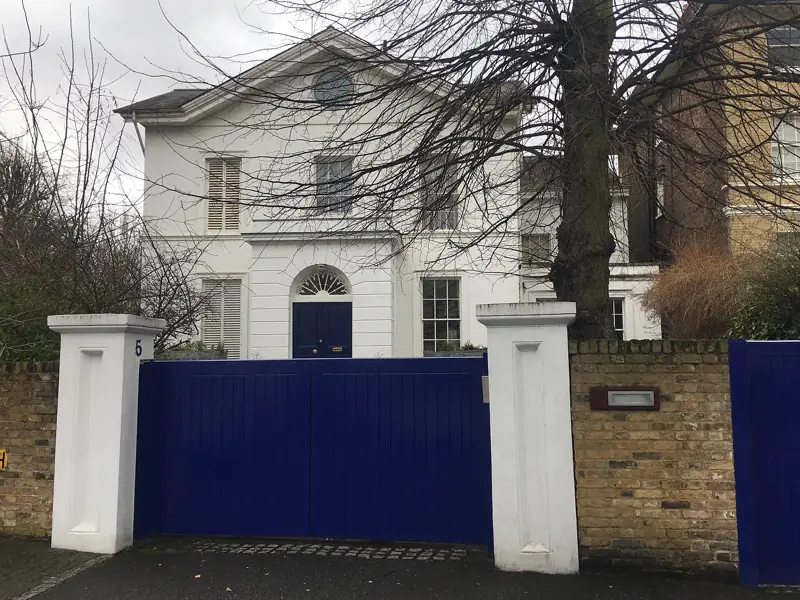
External colour is assessed as part of the building, not as a preference that stops at your boundary. Westminster's repairs guidance says that external painting which affects character may need consent, that previously unpainted surfaces should normally stay unpainted, and that colour and paint type affect the unity of a terrace. Historic England makes a similar point about character-changing repainting, including painting a wall that was bare and making a pronounced colour change. The practical brief is a pair of records: a note of what is coated now, and a sample of what is proposed, viewed against the neighbouring houses in the group. If the terrace is only partly stuccoed, do not let the sample drift onto brick that has never been painted. If the house is one of a designed pair, look at the pair before you isolate your half. None of this is a decision the decorating specification can take by itself. It is the material you give to the person who must say whether consent, or further advice, is required. Neighbouring paintwork, however fresh, is not that advice. Older guidance still has to be read with the council's current consent pages and with the adopted framework.
Sources: Westminster: repairs and alterations to listed buildings; Historic England: advice on redecoration; Westminster: conservation areas and boundary maps
A list entry for a group is not a rule for the street
Listing is granular. Historic England's entry 1357073, for example, covers 5–15 odd on Hamilton Terrace: a Grade II terrace of about 1830, yellow brick in Flemish bond, stucco dressings and basement, panelled doors, radial fanlights and sashes. The entry itself is the limit of that description. It does not make the rest of Hamilton Terrace the same terrace, and Hamilton Terrace is not a conservation area of its own. It is discussed within the St John's Wood audit. The habit this example teaches is the one to use everywhere. Find the list entry for the address, read what it actually protects, and do not borrow a neighbour's entry because the street feels consistent. Then check the conservation-area map, because a house can sit in a conservation area without being listed, or be listed inside one. Article 4 controls, where Westminster or another council has made them, are a further check and they too are address-specific. The decorating schedule comes after those documents, not before. When you write it, use the entry's nouns for the features you propose to treat, so a door, a fanlight or a sash is not hidden inside the word frontage.
Sources: Historic England: 5–15 (odd) Hamilton Terrace, list entry 1357073; Westminster: Hamilton Terrace and mews; Westminster: conservation areas and boundary maps
Adjoining streets and wider work
Consent questions for painted period fronts are also discussed for the adjoining streets by Primrose Hill painters and decorators and Marylebone painters and decorators.
Where a listed building needs work beyond redecoration, that wider repair sits with Hampstead Renovations.
If a listed facade needs investigation before a decorating specification is settled, that step can be discussed with Hampstead Chartered Surveyors, our sister surveying and building consultancy firm.
Request a quotation
Tell us about your property.
Share the address, the rooms or surfaces, and what you have in mind.
Your project details
Tell us what you would like to decorate and where.