St John’s Wood Painters & Decorators
Materials, colour and touch
A finish is more than its colour. Consider how it meets the surrounding materials and what the surface needs from it.
Build a surface schedule
Record the manufacturer, product, colour reference and sheen for each wall, ceiling and piece of joinery. Keep internal and external systems separate. Where an existing finish is retained, identify it as clearly as possible before choosing the adjoining work.
Review samples where they will be used
Look at samples beside the flooring, fabrics and stone already in the room. Compare them in daylight and with the usual evening lighting. Include the ceiling and woodwork in that conversation, since their relationship with the walls shapes the result.
Follow the relevant technical information
Check the selected product's preparation, application and care instructions. If the substrate or earlier finish is uncertain, investigate before specifying a coating. For historic fabric, include any specialist advice or consent requirements in the materials decision.
Carry the palette through the property
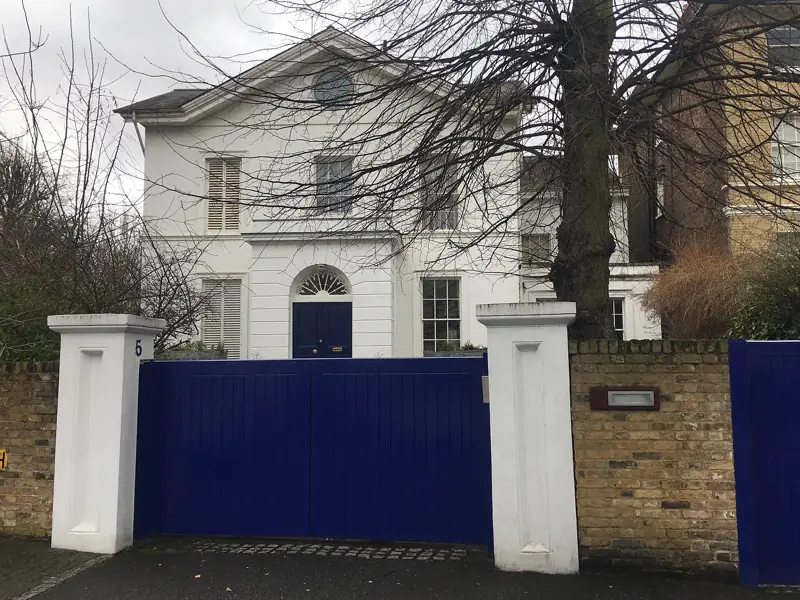
For a St John's Wood villa, review adjoining rooms together where open doors give a view from one to the next. Compare a proposed wall finish with retained shutters, a stair handrail or the entrance joinery, and identify which of those details will actually be repainted. In a mansion flat around the High Street, include the hall when selecting room colours, while keeping shared-building finishes outside the private palette unless they are part of the agreed work. If the scheme also includes exterior stucco or timber, give those surfaces their own product schedule rather than extending an indoor specification outside.
Keep the record after the room is finished
Retain the exact references and the guidance on curing and cleaning. Discuss how any remaining material will be labelled and stored. When a later repair is needed, these details are more useful than a general description of the original colour.
Primer, undercoat and finish specified as one system
A colour reference is the last line of a system, not the system itself. The maker's sheet will usually describe what the finish can go onto, which primer belongs with it, how long it needs before a recoat, and how it should be cleaned once cured. Those instructions are part of the specification. Copy the relevant ones into the schedule rather than trusting that everyone on the job has used that tin before. Existing coatings matter as much as the new product. A sound water-borne film and an old oil film do not always take the same next coat. If you cannot identify what is there, say so, and allow for a test or for advice before the full quantity is ordered. Stain-blocking primers, masonry primers and joinery primers are not interchangeable because they are all called primer. Name the one the sheet requires for that substrate. New plaster wants the treatment the sheet gives for new plaster, which is often a mist coat and a wait, rather than a full-bodied finish on day one. Keep interior and exterior systems in separate tables even when the colour names match.
Masonry coatings outside and emulsions on the rooms within
Exterior masonry and interior walls can share a family resemblance on a chart and still be the wrong product for each other. A wall outside is rained on, warmed and cooled, and sometimes built of a lime-rich stucco that needs a coating able to let moisture move. Historic England's redecoration advice is precisely about that suitability, and it declines to name one coating for every old surface. Inside, a ceiling or a bedroom wall is judged on opacity, on how it looks in the room's light, and on how it will be cleaned. A kitchen or a narrow hall may push you towards a film that can be washed, which may mean a different sheen from the drawing room. None of those interior criteria makes a product suitable for a cill that faces weather, or for ironwork. Read the sheet for the place of use. If the outside substrate is unknown, do not close the specification with an interior emulsion because the sample looked right on a card. Record the outside system beside the elevation, with any constraint from a listing or from advice about previously unpainted brick. Record the inside system beside the room.
Sources: Historic England: advice on redecoration; Westminster: repairs and alterations to listed buildings
Sheen, washing and the note the next repaint will need
Sheen is a maintenance decision as well as a visual one. Flatter paints hide undulation and mark more readily under cleaning. A slight sheen on joinery resists scuffs from hands and bags, and it shows every ripple the preparation left behind. Choose with both facts in view, on a sample next to the wall colour, in the room. Write the result down room by room. Ceilings often sit a step flatter than walls so that they recede. Doors that are handled daily may sit a step harder than the wall beside them. The maker's cleaning advice belongs in the handover note: what may be used, and when, because a film that is still curing will gloss under a damp cloth. Label any leftover tin with the room and the surface, and keep the sample board until you are sure the note is complete. If several near-whites meet at an architrave, the label matters more than memory. External coatings need their own note, including the product used on joinery as distinct from stucco. This record is not a guarantee that a future touch-up will disappear. It is the only way a future touch-up has a chance.
Request a quotation
Tell us about your property.
Share the address, the rooms or surfaces, and what you have in mind.
Your project details
Tell us what you would like to decorate and where.