The decorating notebook
Access, parking & match days
A workable access plan starts at the kerb and ends in the room. Treat parking, unloading and storing materials as separate decisions.
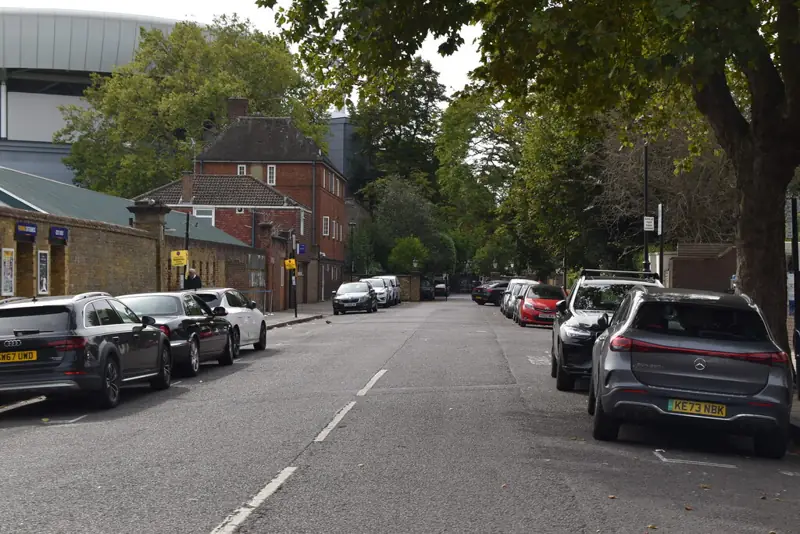
Identify the zone and the bay
Westminster provides a controlled-parking map through its current parking guidance. Check the exact location, street signs and restrictions for the day of the work, particularly near a zone or borough boundary. A nearby space may have different conditions from the one outside the address; do not carry an assumption from one bay to another.
Sources: Westminster: parking zones and charges; Westminster: controlled-parking map
A trade permit is not a reserved space
Check whether the proposed parking place is eligible under Westminster's trade-permit rules and whether the correct zone is covered. Agree who will organise the necessary arrangements. Where the work needs a dedicated access area, establish the appropriate permission with the authority; a permit alone does not establish that the space will be available.
Check Lord's dates before arranging deliveries
On major match days, Westminster extends nearby resident-bay controls to Saturdays, Sundays and bank holidays. Flap-down signs show when the restrictions apply. The council also sets a Sunday and bank-holiday maximum stay in High Street Pay to Park bays during specified hours. Consult the live guidance and signs rather than assuming a weekend delivery can remain for the full working day.
Red routes need a separate check
TfL's red-route rules use signs and road markings to govern stopping and loading. Check the actual approach and intended unloading point if it is on that network. Do not treat a Westminster parking permission as authority to stop on a TfL red route. Record a lawful alternative if the intended place is unavailable.
Sources: TfL: rules of red routes
Finish the plan inside the building
Photograph narrow entrances and stair turns, record lift restrictions, and agree where material can be kept without blocking a route. Include protection for common parts and a contact for building access. This information makes the decorating sequence more realistic and prevents an apparently straightforward room brief from overlooking the journey to it.
Zone C1 on a 2011 map, and the sign that overrides it
Westminster's current parking guidance links a controlled-parking map. That map, reviewed for this site, shows C1 across central St John's Wood, with other zones near the boundary. The sheet itself is dated February 2011. Its hours are not repeated here, because a map of that age is a clue to which zone to ask about, not a timetable you can work from. Before a decorating delivery is arranged, read the sign at the bay you intend to use, on the date you intend to use it, and confirm the address against the council's current pages. A bay one street away, or the opposite side of a boundary street, can sit in a different zone. The map is useful because it stops the assumption that the whole district is a single regime. It is useless as a promise that a space will be free, or that the restriction printed years ago is the restriction in force on a Monday morning. If the work is near a borough boundary, say which side of the boundary the vehicle will actually stand on. Camden's kerb is not Westminster's kerb.
Sources: Westminster: parking zones and charges; Westminster: controlled-parking map
Eligible bays, zone edges and a permit that holds no space
A trade permit is a permission to use certain places, not a reservation of one of them. Westminster's rules tie that permission to the zone and to whether the parking place is eligible. Restrictions still apply, and on a boundary street the side of the road can matter. Agree who will obtain whatever permit or suspension the method needs, and do not treat the application as the same thing as a gap outside the door. If the work needs a particular length of kerb for a tower or for unloading long materials, that is a separate request to the authority. It should be in the brief early, because the decorating sequence depends on it. Write down the vehicle, the time it must stay, and the route from that stopping point to the room. A permit for the wrong zone, or for a bay type the rules exclude, does not become valid because the address is close. Check eligibility for the place you mean. If that place fails the check, name another lawful one before the start is discussed.
Red-route markings at the unloading point
Some approaches in this part of London are on the TfL red-route network, and many local streets are not. The only safe method is to look at the kerb you intend to use. TfL's rules put stopping and loading under the signs and the road markings at that point. A Westminster bay permission, a resident permit or a trade permit does not transfer onto a red route. If the convenient place is marked so that you cannot stop for the time you need, the access plan needs another place, not a shorter stop in the hope that it will be overlooked. Record that alternative, and the walk from it to the door. For a mansion block, the second half of the journey is the lift or the stair, the protection of common parts, and a spot to set materials down that does not block a neighbour. For a house, it may be a garden path or a side passage that will not take the same load as the pavement. Match-day controls near Lord's are a further overlay on nearby resident bays, shown by flap-down signs, and they do not rewrite red-route markings. Check each system on its own signs.
Sources: TfL: rules of red routes; Westminster: parking near Lord's Cricket Ground
Adjoining streets and wider work
Access, deliveries and street permissions are also set out for the adjoining streets by Primrose Hill painters and decorators and Paddington painters and decorators.
Request a quotation
Tell us about your property.
Share the address, the rooms or surfaces, and what you have in mind.
Your project details
Tell us what you would like to decorate and where.