St John’s Wood & its neighbourhoods
Alma Square heritage painting and the garden square
The heritage question on Alma Square is how to repaint a stucco terrace without damaging a place the audit calls easily spoilt, around a garden the law treats as a square.
Left out, then argued back in
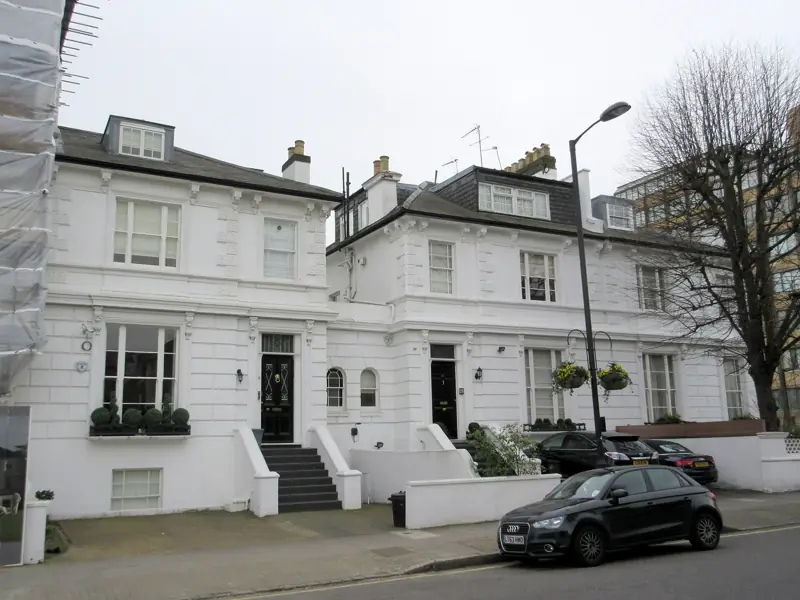
Hamilton Gardens and Alma Square were a departure from the original garden-suburb architecture of St John's Wood. The audit says that is why they were left out of the first designation, and why they were later judged to be of significant value in townscape terms and brought into the argument for the area. That history matters for painting. This is not an early villa pair in its own garden. It is a stucco terrace around an enclosed garden, next to four red-brick Gothic terraces. The value the study names is the townscape of that contrast and of the secluded square. Heritage painting keeps the contrast. It does not 'villa-fy' the stucco with a finish borrowed from a detached house on another road, and it does not paint the square to match Hamilton Gardens' brick.
A backwater that alterations can spoil
The enclave is called a charming secluded backwater with a distinct sense of place which could not be readily reproduced and could be easily spoilt by insensitive alterations. The wider audit lists insensitive painting of stucco among the ways the garden suburb's character is gradually spoilt. On Alma Square those two sentences point at the same risk. A coating that is too thick, too shiny, too contrasting, or laid over failed render, is an alteration of the thing the study asked to keep. There is no separate paint code printed for the square. The practical standard is the one Westminster gives for stucco generally: a limited range of shades, gloss or eggshell, no texture, no excessively glossy film, and fair-faced brick left alone. If a house is listed, like-for-like redecoration usually avoids the need for listed-building consent, and painting a bare surface is the change that is likely to need it.
The protected garden is not a site compound
The garden enclosure is a protected London square under the London Squares Preservation Act, as the audit explains it. The northern boundary is the rear of Nos. 1-1- Alma Square. The southern boundary is the rear of Nos. 25-39. The wording of the northern numbers is the audit's, including the printed form. The purpose the audit records is to keep the ground as ornamental garden or as a place for play, rest or recreation, and to stop building that is not needed for that use. Decorators do not erect structures on it. They also do not store paint, wash brushes into the beds, or leave scaffold parts on the grass. The enclosure is described as one of the more intimate shared green spaces, at a smaller scale than the Bayswater squares it is compared with. Rear elevations that look onto it are part of that intimacy. A heritage specification either includes them, with a method for getting there, or it excludes them in writing. Silence is how a garden front gets a careless coat.
Method, consent and what we will not do
The survey walks the street side and, where we are asked, the garden side. Hollow stucco is marked for repair before decoration. Previously unpainted surfaces are photographed and left. We do not propose to paint brick piers or boundary walls that are still fair-faced. Colour is checked against the run, in the light of the square, because the gap between fronts is the tightest in the conservation area apart from mews and closes, and a mismatch cannot hide. Streets generally sit 25m or 30m apart. This one does not. If you already have advice from the council, it comes to the survey. If you do not, and the proposal is more than refreshing the existing painted stucco, we say so and wait. Lead-safe practice applies where old paint on joinery is disturbed: no blow lamp, no gas torch, no dry sanding, sound paint left in place. Internal schemes, if the house is listed and a decorative ceiling survives, are preserved rather than painted out.
Cost drivers for heritage work on the square
Repair of failed stucco, inclusion of the garden elevation, access through a protected enclosure, detail that must not be clogged, and any consent for a listed house or a change of finish are the things that move the quotation. A straight refresh of sound, already painted stucco on the street side is a smaller scope than a two-elevation repair with scaffold and a colour change. We do not publish a price for either. The quotation follows a visit and is itemised, with the garden either in or out, and with exclusions for bare brick and for work the Direction or a list entry would forbid. Occupied homes add protection of paths and a sequence that keeps a way in. Ask for the quotation with the house number and a note of whether the rear onto the enclosure is required.
Questions about Heritage painting
Why is Alma Square treated as heritage if it is not an early villa?
The audit says Hamilton Gardens and Alma Square depart from the original garden-suburb architecture, were left out of the first designation, and were later judged of significant townscape value. The stucco square is part of that value.
What are the garden boundaries the audit prints?
The enclosure is bounded on the north by the rear of Nos. 1-1- Alma Square and on the south by the rear of Nos. 25-39 Alma Square. It is a protected London square.
What sort of painting does the audit treat as harmful here?
The enclave could be easily spoilt by insensitive alterations, and the wider study names insensitive painting of stucco among the ways the area's character is spoilt. Thick, contrasting or textured coatings are the practical reading of that warning.
Related reading
- Alma Square place guide, garden bounds and townscape value
- Heritage painting as a service
- Exterior painting of the stucco fronts on Alma Square
- Hamilton Gardens, the red-brick terraces beside the square
- Heritage painting under the Abbey Gardens Article 4 Direction
- Local guide to period homes in St John's Wood
Adjoining streets and wider work
Stucco around a garden square is also described by Paddington painters and decorators.
Where a listed building needs work beyond redecoration, that wider repair sits with Hampstead Renovations.
If a listed facade needs investigation before a decorating specification is settled, that step can be discussed with Hampstead Chartered Surveyors, our sister surveying and building consultancy firm.
Request a quotation
Tell us about your property.
Share the address, the rooms or surfaces, and what you have in mind.
Your project details
Tell us what you would like to decorate and where.