St John’s Wood & its neighbourhoods
Abbey Gardens heritage painting and Article 4 rules
Heritage painting on Abbey Gardens is less about a historic colour recipe and more about what the Council has already decided must not be casually altered.
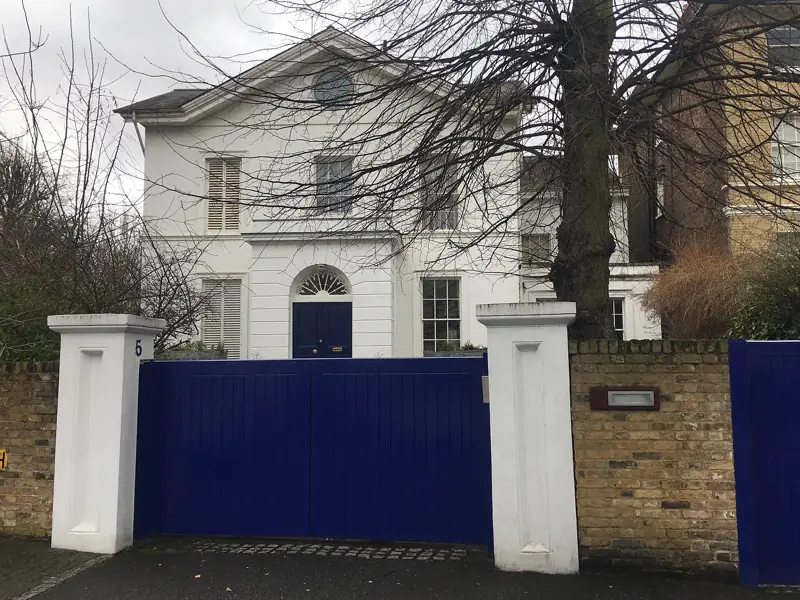
Why this terrace was singled out
The audit does not treat every yellow-brick street in St John's Wood as equally fragile. It picks out Marlborough Place together with the excellent mid-Victorian terraces in Abbey Gardens as a group worthy of preservation. The later terraces themselves are dated to the 1860s: conventional houses, three storeys, yellow brick, half stuccoed. The special-character argument in the Article 4 note is that front elevations were vulnerable to changes which would not normally need permission. Painting the brickwork, and putting up satellite dishes, are the examples given of alterations that would seriously disfigure the buildings. Heritage work here begins with that sentence. The aim is to keep the half-stucco composition readable, not to give the terrace a new skin. A proposal that coats the brick to 'tidy' mismatched patches is the proposal the Direction was written to catch.
Two controls, and they are not the same
The Direction applies to Nos. 1-47 (odd) and 2-56 (even). It covers development affecting the external appearance on the street side, including painting of the exterior except the door. That is a planning control. It is not, by itself, listed-building consent. Westminster's listed-building note is a second test, used only if the particular house is listed: painting the outside needs consent where it affects special character, and a surface that has not been painted should not normally be painted. Historic England's advice sits beside that. Like-for-like external redecoration, matching type, texture, finish and colour, usually does not need listed-building consent. Painting something that is currently bare is likely to. The Planning Portal's ordinary rule, that repainting a house does not need planning permission, is expressly subject to those exceptions. On this street the Article 4 exception is the one to read first, and the list entry is the one to read second. We do not collapse them into a single form, and we do not tell you that a neighbour's recent colour is an approval.
What a heritage specification refuses
It refuses a coating on fair-faced brick. Westminster's stucco guide says fair-faced brickwork should never be painted, and the Abbey Gardens note says painting this brickwork would seriously disfigure the appearance. It refuses a textured masonry paint. The stucco guide wants gloss or eggshell, not texture, and it warns against an excessively glossy film. It refuses a colour chosen to make one house jump out of the run. Across St John's Wood, stucco has generally been kept to a limited range of shades so that contrasting colours do not break terraces and groups. It refuses to strip sound historic paint for the sake of a bare substrate, because older household paint can contain lead and because sound paint is better left. It refuses blow lamps and gas torches on that paint. If a decorative scheme inside a listed house survives, Westminster asks that it be preserved. Internal painting is generally not controlled, but that is not a licence to scrape off a ceiling painting. The street-facing control is the one that governs the outside of these numbers.
Working on a terrace the audit wants kept
Because the group is described as worthy of preservation, the survey looks along the run as well as at the one house. Patched stucco, a cornice that has been roughly filled, a balcony that has been painted into the brick: those are the harms a redecoration can either repeat or avoid. Preparation is local. Hollow render is repaired. Ornament is not sanded soft. The door, excluded from the paint control, can still be a joinery job with its own finish, and if the building is listed the advice about painted doors is that they should stay painted rather than be stripped for stain or varnish. Access on these tight plots is part of the heritage method only in this sense: scaffold and a fan must not become an excuse to daub the brick 'while the tower is up'. The written scope states the surfaces that will be coated and the surfaces that will be left. If permission is required, the specification waits. We do not start a colour change on a controlled elevation and call the paperwork a follow-up.
What changes the price, without a figure
Consent is a cost driver because it changes what may be done and when. A like-for-like refresh of already painted stucco is a different enquiry from a proposal the Direction was meant to prevent. Making-good of the half-stucco, as opposed to a sound surface that only needs cleaning, changes the labour. Iron balconies and a heavy cornice add detail that cannot be sprayed over and cut in later without clogging. The narrow frontage and the lack of a garden change access and the licence. Lead-safe preparation, where old paint is disturbed, takes longer than a clean modern film and uses methods that do not burn or dry-sand. An occupied house changes protection and the order of the bays. None of those sentences is a price. The way we quote is a site visit and a written itemised quotation that separates repair, decoration, metalwork, access and any excluded brick. Ask for that quotation with the house number, so the Direction can be read against the address rather than against the street.
Questions about Heritage painting
Is ordinary repainting free of planning control on Abbey Gardens?
Not on the numbers the Direction names. Nos. 1-47 (odd) and 2-56 (even) are covered for street-facing exterior painting, except the door. The Planning Portal's general rule for house repainting is subject to Article 4 and listing.
Does heritage painting include coating the yellow brick?
No. The houses are half stuccoed yellow brick, and the audit says painting the brickwork would seriously disfigure them. Fair-faced brick is left unpainted.
How does listing differ from the Direction?
The Direction is a planning control on those street elevations. Listed-building consent is a separate test if the house is listed. Like-for-like redecoration usually does not need that consent. Painting a currently unpainted surface is likely to.
Related reading
- The Abbey Gardens place guide and its Article 4 numbers
- Heritage painting for period houses in St John's Wood
- Exterior painting of the half-stucco Abbey Gardens fronts
- Colour advice where the street-facing paint is controlled
- St Anne's Terrace, a palace-fronted stucco range
- How listing and colour consent are checked before decoration
- A local guide to painting period homes in St John's Wood
Adjoining streets and wider work
Part-stucco terraces of this kind are also described by Primrose Hill painters and decorators.
Where a listed building needs work beyond redecoration, that wider repair sits with Hampstead Renovations.
If a listed facade needs investigation before a decorating specification is settled, that step can be discussed with Hampstead Chartered Surveyors, our sister surveying and building consultancy firm.
Request a quotation
Tell us about your property.
Share the address, the rooms or surfaces, and what you have in mind.
Your project details
Tell us what you would like to decorate and where.