St John’s Wood & its neighbourhoods
Abbey Gardens colour advice for the Article 4 fronts
Choosing a colour for Abbey Gardens is a street decision. The bay is narrow, the terrace repeats, and the Council already controls painting of the street-facing exterior except the door.
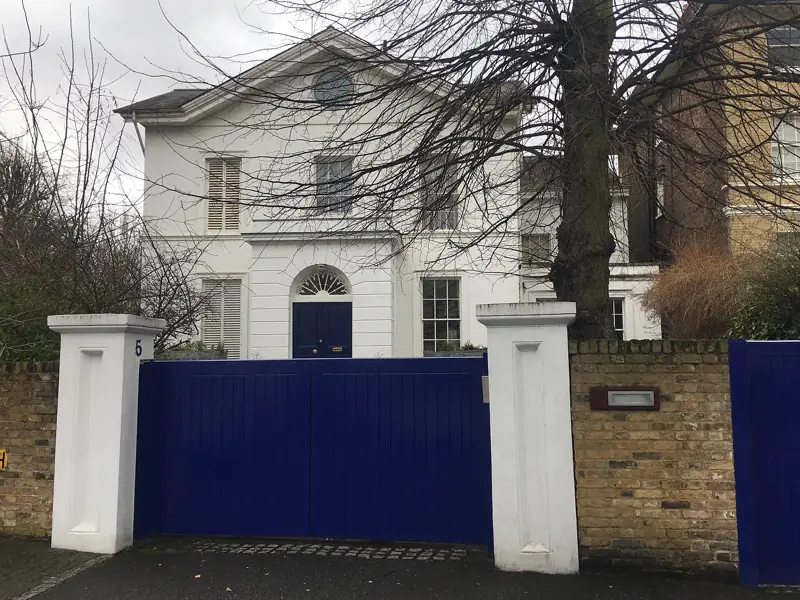
The elevation the colour has to fit
These later terraces are 1860s houses of yellow brick, half stuccoed, with iron balconies on pillars, a pronounced cornice, consoles and pediments at first floor, and simple surrounds above. A colour scheme that ignores that hierarchy will fight the architecture. The first-floor dressings are the enriched part. The upper floor is deliberately quieter. The balcony is a dark metal line, not a place for a third masonry colour. The yellow brick is not a paint colour at all. Across the conservation area, stucco is generally kept to a limited range of shades precisely so that contrasting colours do not disrupt terraces and groups. On a frontage in the region of 5.5m, with little or no front garden, one odd shade is seen with both neighbours in the same glance. The sample that matters is the one held on the stucco in daylight, next to the brick, not a chip viewed in a kitchen.
Shades the stucco guide actually names
Westminster's stucco guide points to BS 4800 colours 10B15, 08B17 and 08B15 for external stucco, chosen to match the predominant shade of the terrace or group. Those references are a starting set, not a claim that every house on Abbey Gardens was painted to one of them, and not a product we insist on by brand. The test in the sentence is the group. If the run is a warm stone colour, a bright white or a deep tint breaks it. The finish is gloss or eggshell. Textured paint is out. An excessively glossy coating is warned against, because it reads as a plastic skin on modelled stucco and on a cornice. The consultation records the reference, the sheen and the surface it belongs to. It does not record a single 'house colour' that then migrates onto the door, the iron and the brick. Three decisions are written down: the stucco shade, the iron, and the door. They can be related. They are not the same chip.
The door is the one the Direction excepts
On Nos. 1-47 (odd) and 2-56 (even), painting the street-facing exterior is controlled except the door. That split is useful in a colour conversation. The wall shade is the item most likely to need permission if it changes. The door can carry a different colour without that sentence treating it as the same application. It can still look wrong. A door that shouts against a quiet stucco run is a townscape mistake even when it is lawful. In the conservation area more widely, typical front doors are painted black, with occasional other colours, and fanlights are simply detailed. Abbey Gardens is not given its own door chart. We use the wider note as context and the Direction as the rule for the wall. If you want a strong door colour, the consultation shows it against the proposed stucco and the yellow brick before it is specified. If the house is also listed, a change of paint finish, such as matt to gloss or a smooth coating to a textured one, is the kind of change Historic England says would usually need consent.
How the consultation is done
We start from the address, because the Direction is numerical. Then we look at the bay: how much is stucco, where the brick begins, how heavy the cornice is, whether the pediments are crisp or clogged. Large samples, not fingertip chips, are compared in the light the terrace actually gets. Neighbours are noted so the predominant shade is a description of what is there, not a guess. The written note names each surface and the decision for it, including surfaces that stay unpainted. It also says what is still unknown, such as an unchecked list entry. The note is something the decorating specification can carry. It is not itself the permission. If a change to street-facing paint needs an application, the samples and the photographs are what that conversation with the adviser is built from. We do not offer a colour as if it were an approval.
What affects the cost of the advice and the work that follows
A colour note for a single already-painted stucco bay, with the brick excluded and the iron and door left as they are, is a smaller piece of work than a proposal that moves the shade of a whole elevation and needs samples for an application. The cost of the decorating that follows depends on preparation of the cornice and dressings, the condition of the half-stucco, the balcony iron, and access on a plot with little or no garden. Permission, if it is required, sits outside the paint price and can change the programme. None of this is quoted as a package from the postcode. After the visit you receive a written quotation that itemises the consultation, if it is separate, and the decorating surfaces, if you want us to carry the colour into the work. You can also take the note to another decorator. Ask for the visit with a photograph that shows your house and one neighbour either side.
Questions about Colour consultation
Can one Abbey Gardens house take a contrasting stucco colour?
The audit says stucco in St John's Wood is generally a limited range of shades, because contrast disrupts terraces and groups. These fronts are half-stuccoed and tightly repeated. A strong contrast is the harm that guidance describes.
Which stucco references does Westminster name?
The stucco guide recommends BS 4800 colours 10B15, 08B17 or 08B15, chosen to match the predominant shade of the terrace or group, in gloss or eggshell rather than a textured coating.
Is the front-door colour under the same control as the wall?
The Article 4 wording for Nos. 1-47 (odd) and 2-56 (even) controls painting of the street-facing exterior except the door. The door is specified on its own, and it is still viewed against the stucco and the brick.
Related reading
- Abbey Gardens place notes, including the Article 4 numbers
- Colour and finish planning for St John's Wood houses
- Exterior painting once the Abbey Gardens shade is chosen
- Exterior painting on the stucco terraces of Alma Square
- Hamilton Gardens, where the terraces are red brick rather than stucco
- Local guide to period-home painting in St John's Wood
Adjoining streets and wider work
Part-stucco terraces of this kind are also described by Primrose Hill painters and decorators.
Where an older house needs repair as well as decoration, that wider work sits with Hampstead Renovations.
Request a quotation
Tell us about your property.
Share the address, the rooms or surfaces, and what you have in mind.
Your project details
Tell us what you would like to decorate and where.